Question Time to the Government: Culture as a Component of National Security and Ukraine’s International Resilience
Key message: In today’s Ukraine, culture is no longer a secondary policy field. It is increasingly treated as a pillar of national resilience, identity, international subjectivity, and long-term recovery.
During the plenary sitting of the Verkhovna Rada of Ukraine, we at ndu.kr.ua followed the Question Time to the Government with particular attention, as it remains one of Parliament’s central oversight tools and an important instrument of democratic accountability.
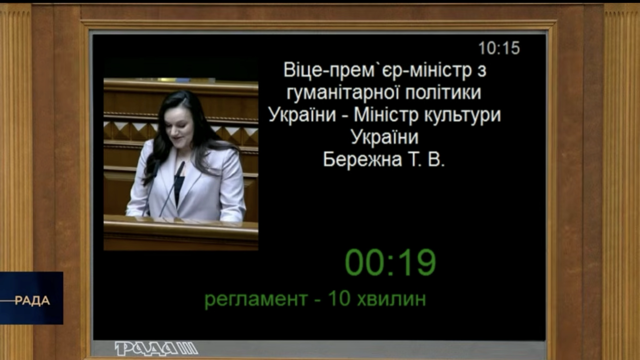
This time, the focus was on humanitarian policy. Ukraine’s Deputy Prime Minister for Humanitarian Policy and Minister of Culture addressed Parliament and answered questions from parliamentary factions and individual MPs. The format itself reflected a balanced parliamentary model: an introductory statement followed by structured questioning from political groups and legislators.
Parliamentary principle: Openness in wartime must be balanced with responsibility. MPs were reminded not to disclose any information that could harm Ukraine’s national security or violate the rules on classified and restricted information.
Culture as a pillar of the state
A central message of the minister’s statement was that culture must no longer be viewed as a secondary area of public policy. Over the past six months, the Government and Parliament have laid the foundation for a new cultural policy and delivered the first practical results.
In this new framework, culture is presented as a pillar of national resilience, an instrument of international subjectivity, and a foundation of Ukrainian identity. In wartime, culture answers the defining questions of statehood: who Ukrainians are as a nation, what they are fighting for, and what kind of country they seek to build after the war.
Strategic shift: Culture is being integrated into Ukraine’s broader security architecture alongside defence, diplomacy, and economic resilience.
Russia’s war against Ukrainian culture
One of the strongest parts of the discussion concerned the scale of destruction caused by Russia’s aggression against Ukrainian cultural heritage. The figures presented in Parliament demonstrate that this is not collateral damage, but a systematic attack on memory, identity, and historical continuity.
Key figures presented during the session:
- More than 1,723 cultural heritage sites damaged or destroyed
- Around 1,500 cultural infrastructure facilities affected
- 513 sites completely destroyed
- More than 35,000 museum objects reportedly stolen
- Over 1.7 million items remaining in occupied territories
These actions point to a deliberate attempt to erase Ukrainian historical memory and absorb Ukrainian heritage into Russia’s own cultural narrative. The war is therefore being fought not only over territory, but also over meaning, identity, and the right to historical continuity.
2025 as a turning point
Core political conclusion: 2025 marks Ukraine’s transition from crisis response to systemic cultural policy. Most importantly, culture has now been officially incorporated into the national security system.
This is a major shift in state thinking. Culture is no longer treated as a merely symbolic or supportive sphere. It is increasingly recognised as a strategic state resource that contributes to resilience, public cohesion, and long-term recovery.
International support and cultural diplomacy
The international dimension of cultural policy was another major theme of the session. On 2 March, Lviv hosted the conference “Cooperation for Dignity”, bringing together 40 international delegations, 10 ministers of culture, international organisations, and expert communities.
Ukraine used this platform to present its wartime experience of protecting culture, showing that it is not only a recipient of assistance, but also a source of valuable expertise for international partners.
International results highlighted in Parliament:
- UAH 100 million allocated by international partners for Ukrainian culture
- Nearly EUR 5 million already raised by the Ukrainian Cultural Heritage Fund
- 28 countries involved in the Alliance of Cultural Value
UNESCO protection and Interpol mechanisms
The session also highlighted progress in international legal protection. According to the information presented, 19 Ukrainian sites have recently been added to the international list of cultural heritage under enhanced protection by UNESCO, while 46 Ukrainian sites are now included in relevant international protection lists overall.
At the same time, 643 cultural objects stolen by Russia have for the first time been entered into the Interpol database. This creates real mechanisms for tracing and returning unlawfully removed cultural property.
Why this matters: Cultural crimes are beginning to receive international legal visibility, and stolen heritage objects now have a more realistic pathway toward recovery.
Evacuation of cultural property
The Government has adopted a resolution on the evacuation of cultural property. This was described as the first comprehensive regulatory decision of its kind since the beginning of the full-scale invasion.
Under the new framework, the area within 50 kilometres of the frontline is treated as an evacuation zone for museum objects. Responsibilities, procedures, and prioritisation mechanisms have now been clearly defined.
Operational outcome: More than 100,000 museum objects have already been evacuated and preserved.
Audit, registries, and governance reform
The parliamentary discussion also pointed to a broader institutional effort to modernise cultural governance. Around 40% of national-level monuments have been entered into the State Register of Immovable Heritage, while about 60% of Ukrainian museums have already completed collection audits.
These technical steps are in fact foundational. Without proper registration, audit, and legal categorisation, heritage cannot be adequately protected, restored, evacuated, insured, or advocated for internationally.
Funding culture and strengthening institutional autonomy
Parliament’s support for culture was also visible in budgetary policy. Funding for culture in the State Budget was increased by 45%, which sends a strong institutional signal that cultural policy is now considered a strategic priority.
At the same time, the Government recognises that public funding alone cannot guarantee sectoral resilience. New regulatory decisions therefore expand the range of paid services that certain cultural institutions may provide, allowing them to generate more income independently while preserving their public mission.
European governance logic: Culture should benefit from public funding, but also develop stronger financial autonomy and institutional capacity.
What this means for citizens
For Ukrainian citizens, these developments have direct meaning. They show that culture is now treated as a matter of national security, that the protection of heritage is becoming more systematic, and that international support is turning into institutional mechanisms rather than one-off gestures.
At a deeper level, these decisions reinforce the idea that Ukraine is defending not only its territory, but also its memory, its identity, and its place in Europe.
Conclusions and next steps
The parliamentary discussion made clear that Ukraine’s cultural policy is undergoing a profound transformation. Culture is increasingly understood as a security issue, a diplomatic asset, and a strategic state resource.
The next steps will likely include expanding international support, completing museum audits, strengthening mechanisms for the return of stolen cultural property, broadening evacuation capacity, and improving the financial sustainability of cultural institutions.
Editorial conclusion: Ukraine is defending not only land, but also memory. The institutionalisation of cultural policy as part of national security is one of the clearest signs that the state is thinking strategically about its future.