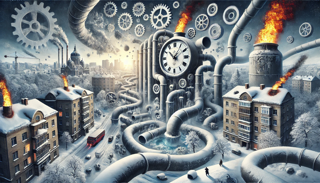
🇺🇦🏛️ On 16 January 2026, during a plenary sitting of the Verkhovna Rada of Ukraine, Question Time to the Government focused on one of the most critical challenges facing the country — the resilience of the energy system amid wartime conditions and continued targeted attacks by the Russian Federation on critical infrastructure.
On behalf of the editorial team of www.ndu.kr.ua, we report that Members of Parliament addressed their questions to the newly appointed First Deputy Prime Minister and Minister of Energy of Ukraine, Denys Shmyhal, who outlined the current state of the energy sector, the Government’s response, and key priorities for the coming period.
Key Government Decisions and Policy Measures
In his address and responses to MPs, the Minister highlighted a set of measures shaping the Government’s approach to energy security this winter:
• The Emergency Situation regime in the energy sector has been reinstated by the Commission on Technogenic and Environmental Safety and Emergencies, enabling faster decision-making, resource mobilisation, and coordinated action between central and local authorities.
• A dedicated emergency response штаб has been established in Kyiv and the Kyiv region to address the consequences of missile and drone strikes on energy facilities. The headquarters operates on a 24/7 basis.
• The network of Resilience Centres is being expanded, with particular attention to Kyiv while keeping all regions in focus. These hubs are equipped with heating, food provision, charging points, and stable communication facilities.
• A nationwide inventory and redistribution of available resources is underway to ensure assistance reaches those communities and citizens most in need.
• A direct appeal was made to the business sector to reduce non-essential electricity consumption, including switching off illuminated outdoor advertising and energy-intensive installations.
International cooperation remains a key pillar of the response. Ukraine continues to work closely with partners to secure generators, energy storage systems, transformers, spare parts, and repair equipment. At the same time, electricity imports from the EU are being increased, with the current maximum import capacity reaching 2.3 GW.
Infrastructure and Technical Priorities
The Government also presented concrete technical solutions aimed at strengthening system resilience:
• Fast-track connection of backup power equipment: each stage — review, approval, and issuance of technical conditions — is now limited to two days.
• Distributed generation shows strong progress: from 225 MW commissioned in 2024 to 762 MW in 2025. However, particular concern was expressed about Kyiv, where slower deployment directly affects the capital’s energy stability.
• Cogeneration and heating infrastructure: more than 250 cogeneration units are already in operation, with around 200 additional projects under development; 187 modular boiler houses have been installed.
• Protection of energy facilities: over UAH 50 billion has been allocated for physical protection and security measures in coordination with the Defence Forces.
Hospitals, schools, and other critical facilities remain top priorities for electricity and heat supply. State-owned companies have been instructed to urgently secure imported electricity covering at least 50 % of their own consumption.
What This Means for Citizens
A separate clarification concerned curfew regulations: citizens are now allowed to move without special permits and use public transport to reach Resilience Centres and heating points — applying an approach similar to that used during air raid alerts.
The situation regarding natural gas reserves remains under control. Imports continue, and domestic production is stable.
More than 15,000 energy workers are currently engaged in repair and restoration efforts, supported by tens of thousands of emergency responders, municipal workers, and police officers working around the clock to restore electricity and heat supply.
Conclusions and Next Steps
From a parliamentary oversight perspective, Question Time on 16 January confirmed that energy security remains a top national priority. The Government has demonstrated readiness to act swiftly, mobilising domestic and international resources, while the Verkhovna Rada continues to exercise democratic scrutiny over implementation.
Key next steps include:
• strengthening the role of local authorities and communities in expanding distributed generation;
• further mobilisation of European technical and financial support;
• clear and consistent communication with citizens on available support mechanisms during energy disruptions.
The editorial team of www.ndu.kr.ua will continue to monitor the implementation of these measures and report on their real-life impact for citizens and communities across Ukraine.