Government Question Hour in the Verkhovna Rada: Economic Policy, Business Support and Structural Reforms in Wartime
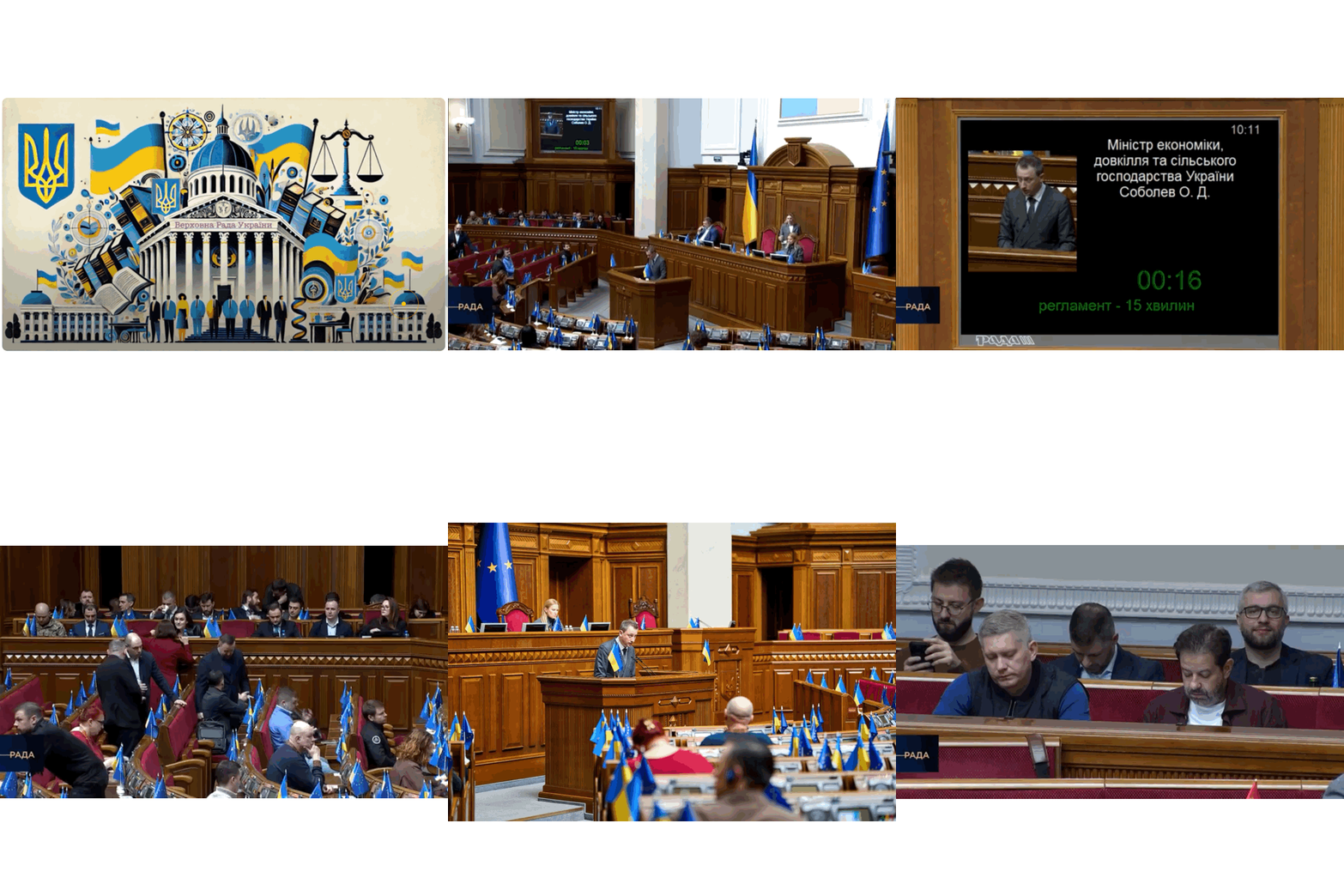
We, the editorial team of www.ndu.kr.ua, continue our coverage of the Government Question Hour in the Verkhovna Rada of Ukraine — a key instrument of parliamentary oversight in democratic governance.
During the session, the Minister of Economy, Environment and Agriculture of Ukraine, Oleksii Dmytrovych Soboliev, presented a comprehensive policy framework addressing current economic challenges and outlining practical steps to support businesses and ensure sustainable growth under wartime conditions.
This part of the discussion marked a transition from diagnosis to implementation-oriented economic policy, grounded in data and institutional measures.
Key Challenges Facing Business in 2026
The Minister acknowledged that 2026 is the most difficult year for Ukrainian businesses since 2022, highlighting several systemic challenges:
- War-related risks: destruction of assets, security threats and uncertainty;
- Energy constraints: unstable electricity supply and high energy costs;
- Labour shortages: lack of qualified personnel;
- Logistics disruptions: broken supply chains;
- Limited access to capital;
- Low economic complexity: insufficient domestic processing and value addition.
We emphasize that this represents a multi-layered economic crisis requiring coordinated policy responses across sectors.
Strategic Objective
The Government’s core objective is clear: to enable Ukrainian businesses to operate, invest and grow faster than the economy of the aggressor state.
This reflects a new paradigm — economic policy as a tool of strategic resilience and geopolitical competitiveness.
Policy Measures: Five Strategic Directions
1. Overcoming Energy Constraints
Key measures include:
- development of new energy generation capacities;
- promotion of on-site power generation by businesses;
- concessional loan programmes under “5-7-9” for SMEs;
- preparation of financing instruments for large enterprises;
- simplified land-use procedures for energy projects;
- introduction of long-term electricity contracts.
Financial indicators:
- energy project loan portfolio: approximately UAH 26 billion;
- new approved applications in February: UAH 700 million.
This signals a shift toward decentralized energy resilience as a foundation for economic stability.
2. Development of Domestic Production (“Made in Ukraine”)
The strategic goal is to increase the share of the processing industry in GDP from 8.5% to 20%.
Key results:
- contribution to GDP growth: approximately 1% in 2025;
- tax revenues from the processing industry: UAH 367 billion, or 18% of total tax revenues.
Budget support for 2026:
- approximately UAH 35 billion allocated to production support programmes.
Policy tools:
- concessional lending under the 5-7-9 programme;
- special conditions for frontline regions;
- localisation policy.
This reflects a strategic transition toward an industrial and value-added economy.
3. Industrial Parks and Investment Promotion
Current progress:
- 37 industrial facilities built or under construction;
- more than USD 250 million in attracted investment.
Additional tools:
- state support for large investment projects;
- grants for processing industries, with more than 1,400 units of equipment installed.
Industrial parks are evolving into a practical instrument of industrialisation, not merely a policy concept.
4. Export Support and Financial Instruments
- support for non-raw exports: UAH 10 billion via the Export Credit Agency;
- extended settlement periods for agricultural machinery exporters;
- expanded access to international markets.
These measures strengthen foreign exchange stability and Ukraine’s integration into global value chains.
5. SME Support and Regional Recovery
- “Own Business” grants: more than 10,000 beneficiaries;
- including 1,600 veterans;
- new grant programmes for businesses affected by attacks;
- targeted support for farmers in frontline areas.
This demonstrates the integration of economic and social resilience policies.
Labour Market Reform and Human Capital
The Government presented a comprehensive employment reform strategy through 2030.
- long-term labour market forecasting with a 10-year horizon;
- launch of the unified digital system Obrig, with Phase I expected in spring;
- programmes for youth entrepreneurship mentoring;
- reskilling for individuals aged 50+;
- wage support for affected businesses;
- improvements in workforce reservation mechanisms.
A major legislative step is the submission of a new Labour Code to Parliament.
Ukraine is moving toward a modern, data-driven labour market model.
Risk Mitigation and Insurance Mechanisms
Since January 1, a wartime risk insurance programme has been launched:
- compensation of up to UAH 30 million per facility;
- insurance premium coverage of up to UAH 3 million;
- applications submitted: approximately UAH 700 million.
In parallel:
- more than 20 international financial institutions are operating in Ukraine;
- more than EUR 15 billion has been mobilised since 2022;
- new financial instruments include the Ukraine–US Fund, the EU Flexible Fund worth EUR 500 million, and venture and technology funds.
A multi-layered financial ecosystem is being established to distribute wartime risks and unlock long-term capital.
Deregulation and Digitalisation
Key reforms include:
- simplification of permit procedures;
- digitalisation of public services;
- risk-based regulatory control.
New measures:
- from April 1, businesses will no longer be required to use work completion acts in certain cases;
- a pilot e-receipts system is being tested.
These reforms are designed to reduce administrative pressure and improve business predictability.
Fuel Price Response: Cashback Mechanism
Instead of tax reductions or price controls, the Government introduced a targeted cashback programme.
- Programme period: March 20 – May 1;
- diesel: 15% compensation;
- petrol: 10% compensation;
- LPG: 5% compensation;
- monthly cap: UAH 1,000.
The cashback can be used for:
- utility payments;
- Ukrainian-made goods;
- medicines and books;
- donations to the Armed Forces of Ukraine.
Initial results:
- 75% of spending goes to utility payments;
- approximately UAH 20 million in cashback is credited daily.
This approach minimizes market distortions while providing targeted social support.
International Support and Fiscal Risks
Ukraine’s economy remains critically dependent on international assistance.
- the key programme is the Ukraine Facility;
- there is a risk of a EUR 5 billion funding gap if necessary reforms are delayed.
The solution, as stressed during the session, is the adoption of the legislative package expected by international partners.
Corporate Governance Reform
Achievements in 2024–2026:
- supervisory boards established in 8 major state-owned enterprises;
- governance reforms launched in Energoatom and Naftogaz;
- recruitment process: 340 applications, resulting in 49 shortlisted candidates.
Ukraine is also moving toward alignment with OECD corporate governance standards, a step that may significantly strengthen investor confidence.
Conclusions and Next Steps
The Government presented a comprehensive and structured economic policy framework focused on wartime resilience and long-term transformation.
The key priorities include:
- energy resilience;
- industrial development;
- labour market reform;
- investment attraction;
- risk-sharing mechanisms for business.
At the same time, international cooperation remains a critical pillar of economic stability. The next phase will depend on the timely adoption of legislation, the scaling of financial support instruments and the acceleration of structural reforms.
For Ukrainian citizens, these policies are not abstract macroeconomic measures. They are directly linked to jobs, energy security, household resilience, support for veterans, and the country’s capacity to sustain both defence and recovery.
Ukraine economy 2026, wartime economic policy Ukraine, business support Ukraine 5-7-9, Made in Ukraine programme, industrial parks Ukraine investment, labour market reform Ukraine, Ukraine Facility EU, wartime risk insurance Ukraine, corporate governance reform Ukraine, fuel cashback Ukraine
We will continue to provide in-depth and structured analysis of parliamentary processes and government policy, ensuring clarity, accountability and alignment with European standards of public communication.