

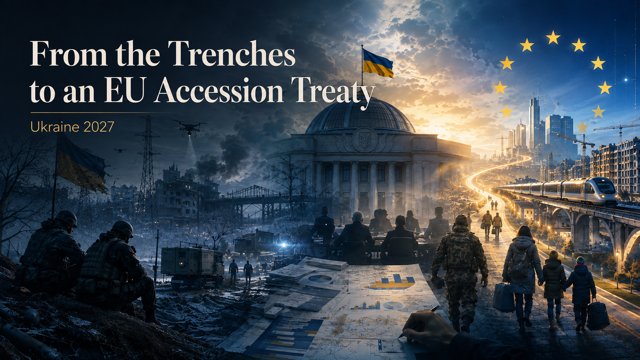
Fight a major war. Survive another winter. Protect the energy system. Rebuild infrastructure. Bring Ukrainians home. Reform the economy. Align hundreds of laws with the European Union. And move towards the final stages of accession negotiations — all at the same time. Ukraine’s new Government Programme attempts to place all of these tasks on one political calendar through 2027.
Editorial note. Draft Resolution No. 15521 on the Programme of Activities of the Cabinet of Ministers of Ukraine was registered in the Verkhovna Rada on 17 August 2026. At the time of publication, the document remains under parliamentary consideration. This analysis therefore examines the Government’s proposed programme, not an already approved parliamentary decision.
In a country entering the fifth year of Russia’s full-scale invasion, the future is no longer an abstract political concept.
For a soldier, it may mean ammunition, rotation, medical support and technological superiority.
For a family living near the front line, it may mean something more immediate: whether there will still be electricity, heating and running water after the next missile or drone attack.
For an internally displaced person, the question may be whether temporary accommodation can finally become a permanent home.
For a Ukrainian family now living in Berlin, Warsaw or Prague, it is whether returning home can once again become a rational choice rather than an emotional wish.
And for a foreign investor, the question is whether a country fighting Europe’s largest war in generations can simultaneously build institutions, rules and infrastructure compatible with the European Union.
Ukraine’s Cabinet of Ministers is attempting to answer all of these questions in a single document.
Its Programme through 2027 is ambitious not because of any one promise.
It is ambitious because of the number of historic transformations Ukraine intends to pursue simultaneously.
A state fighting a war while rebuilding itself
The Programme is structured around four broad priorities: strengthening resilience and moving towards a just peace; restoring and developing human capital; building a capable European state; and accelerating recovery and economic development.
These priorities are divided into 12 strategic goals and then into operational objectives, individual ministerial responsibilities and performance indicators.
The architecture matters.
Ukraine is attempting to strengthen its armed forces and defence industry, protect critical infrastructure, prepare for another winter, support veterans and displaced people, create conditions for citizens to return from abroad, modernise its transport and energy systems, attract private investment and simultaneously align its state institutions and legislation with the European Union.
Ukraine is asking one state apparatus to operate as a wartime mobilisation system, a social state, an EU candidate country, the manager of an enormous reconstruction effort and the foundation of a future private-sector-led economy — simultaneously.
Any one of these tasks could define an entire government term.
Ukraine intends to pursue them in parallel.
That is why the most important word in the Programme may not be “reform”.
It is capacity.
Winter will be the first real test
The Government identifies stable passage through the coming winter as one of its immediate tactical objectives.
In wartime Ukraine, that is not simply an energy-policy issue.
Electricity, heating, water, hospitals, schools, telecommunications and transport have all become components of national resilience.
The Ministry of Energy plans repairs to generating equipment with a combined capacity of at least 8 GW, further engineering protection of critical energy infrastructure and the deployment of at least 800 MW of distributed gas generation, including at least 200 MW from state-owned energy companies.
The Ministry of Internal Affairs plans emergency readiness involving generators with a combined capacity of 280 MW and heat generators totalling 44 MW, together with further inspection of civil-protection shelters.
The social-policy component includes winter assistance of UAH 19,400 for approximately 350,000 households.
Infrastructure authorities are expected to coordinate resilience plans for regions and cities and prepare municipal systems for the 2026–2027 heating season.
In a government document, these are megawatts, assets and budget lines.
For citizens, the metric is different.
Can a hospital continue an operation when the grid fails? Can a pumping station keep water flowing? Can a city restore heating after another strike on critical infrastructure?
Winter will therefore be the first major test of whether the Programme works outside the pages of a government document.
Not as a presentation. As physical reality.
Defence: measurable ambitions — and external dependencies
The defence section moves beyond familiar political language about “strengthening defence capabilities”.
The Government sets a target of meeting 100 per cent of the Armed Forces’ priority requirements for weapons, military and specialised equipment, missiles and ammunition.
It also seeks to reduce by threefold the average time between identifying a priority technological requirement and introducing a corresponding solution.
At least ten priority technologies are expected to be deployed and scaled with a measurable positive impact on the battlefield.
Then comes one of the Programme’s largest numbers.
Ukraine aims to secure at least €60 billion in EU-backed credit financing for weapons and military equipment in 2026–2027, with at least half intended to support products manufactured by Ukraine’s own defence-industrial complex.
As an industrial and strategic objective, this is significant.
As a performance indicator, however, it illustrates one of the central challenges in evaluating the entire Programme.
Kyiv can reform defence procurement, improve testing procedures, support domestic producers and expand production.
But Ukraine cannot unilaterally decide that European partners will provide tens of billions of euros.
Some government targets are therefore directly controllable.
Others depend on Parliament.
Others depend on foreign partners.
And some depend on the course of the war itself.
Any serious assessment of the Programme will eventually have to distinguish between these categories.
The Government is not starting from a blank legislative page
For international readers, one point is particularly important.
Much of this reform agenda did not suddenly appear with the new Government Programme.
In February 2026, the Verkhovna Rada — Ukraine’s national parliament — approved its legislative work plan for the year, containing 389 legislative tasks.
The plan already included a substantial body of legislation linked to EU integration, public administration, transport, social policy, environmental regulation, the economy and digital transformation.
Many of the priorities now presented by the Cabinet therefore overlap with reforms that were already moving through Ukraine’s legislative pipeline.
These include housing reform, labour legislation, transport regulation, alignment with EU environmental rules, public-administration reform and numerous components of the accession process.
Programme No. 15521 does not invent Ukraine’s entire reform agenda. Its importance is that it brings legislative, financial, international and sectoral obligations into a single political framework of Cabinet responsibility.
Parliament already has a legislative pipeline.
The Government is now attempting to place that pipeline on a common timetable of political results through 2027.
Why parliamentary approval matters
For readers outside Ukraine, a Government Programme can sound like another strategic policy paper.
In the Ukrainian constitutional system, this one has greater political significance.
The Programme requires the support of a majority of the constitutional composition of the Verkhovna Rada.
Approval also has consequences for the constitutional mechanism of collective government responsibility.
Under Article 87 of the Constitution of Ukraine, Parliament may not consider a resolution on the responsibility of the Cabinet of Ministers during the year following approval of the Government Programme.
A parliamentary vote on the Programme is therefore not merely an endorsement of policy targets. It also has implications for the political stability of the Cabinet as a collective institution.
That makes precision particularly important.
If Parliament grants the Government a stronger horizon of institutional stability, it should simultaneously demand a stronger framework of accountability.
Deadlines should be clear.
Responsibilities should be attributable.
Financing should be identifiable.
And results should be measurable.
Ukraine is attempting to compress its EU timetable
The European-integration section is among the most ambitious parts of the Programme.
Ukraine’s accession negotiations have already entered a practical phase.
The Programme sets the objective of advancing negotiations across the remaining clusters, including the Internal Market, Competitiveness and Inclusive Growth, the Green Agenda and Sustainable Connectivity, and Resources, Agriculture and Cohesion.
For 2027, the Government goes further.
It wants Ukraine to fulfil the conditions necessary to be ready for the closure of all negotiation chapters and to begin preparations for a draft Treaty of Accession to the European Union.
That language requires caution.
Being ready to close negotiation chapters does not mean that every chapter will automatically be closed.
Beginning preparations for an accession treaty is not the same as having an agreed date of membership.
EU enlargement decisions depend not only on Kyiv, but also on European institutions and all member states.
Nevertheless, the direction is clear.
Kyiv is attempting to compress the domestic timetable of European integration.
That carries a major consequence.
The faster the political timetable becomes, the greater the burden on Ukraine’s Parliament, ministries, regulators and civil service.
EU membership cannot be delivered by one government resolution.
It requires a country to adopt, implement and enforce a vast body of European law.
Parliament has already started the clock
The Verkhovna Rada has already established parliamentary mechanisms to support and monitor the EU negotiation process.
The Government is expected to coordinate EU-alignment legislation with parliamentary committees, inform Parliament about consultations with EU institutions and provide regular reporting on the implementation of accession-related obligations.
This gives Parliament an opportunity to transform the Government Programme into something more than a political statement.
It can become a practical accountability matrix.
What was supposed to be completed?
What has actually been completed?
Which law is still missing?
Which institution has not yet been created?
Where is the measurable result?
That may prove more useful than another annual political debate about whether European integration is moving “quickly enough”.
Ukraine Facility: when reform deadlines become financial deadlines
This is also where Ukraine’s domestic reform process directly intersects with European financial support.
The EU’s Ukraine Facility provides up to €50 billion in support for 2024–2027.
A substantial share of that financing is linked to implementation of the Ukraine Plan and achievement of specified reform indicators.
This changes the nature of reform deadlines.
Reform → indicator → assessment → financing.
A missed reform deadline can therefore have consequences beyond domestic politics.
It may also affect the timing of external funding.
Public-administration reform is a good example. The restoration of competitive, merit-based recruitment to the civil service has been explicitly linked in Ukrainian parliamentary materials to obligations under the Ukraine Facility.
Similar conditionality runs through other areas of structural transformation.
This means legislative capacity is no longer only a question of parliamentary efficiency.
It is increasingly part of Ukraine’s financial resilience.
Financing is the Programme’s largest unanswered question
The Programme contains many financial targets.
What it does not contain is a single consolidated estimate of what implementing the entire programme will cost.
The accompanying financial justification states that implementation should be financed within annual state-budget allocations, international financial and technical assistance and other legally permitted sources.
That may be legally sufficient.
For a programme of this scale, however, it leaves an analytical gap.
The Ministry of Finance, for example, targets approximately $49 billion in external support in 2026 and $52 billion in 2027.
International institutions use different methodologies when calculating Ukraine’s financing needs, official flows and financing gaps, so direct numerical comparisons must be treated carefully.
But the difference in methodologies only makes one question more important:
What exactly makes up the Government’s projected external financing for 2026 and 2027?
How much has already been committed?
How much depends on future decisions by the European Union, G7 partners or international financial institutions?
How much depends on Ukraine first delivering specified reforms?
Without such a financing map, even a sophisticated set of performance indicators remains partially dependent on assumptions outside the Government’s control.
Ukraine no longer lacks plans. It risks lacking implementation capacity.
This may be the most important issue for Ukraine’s Western partners to understand.
Ukraine is not suffering from an absence of strategies.
It has strategies.
It has roadmaps.
It has accession obligations.
It has legislative plans.
It has donor programmes.
It has investment pipelines.
The increasingly scarce resource is the institutional ability to implement many complex reforms at once while maintaining legislative quality and continuing to operate under wartime pressure.
Ministries need qualified specialists.
Parliamentary committees need sufficient expertise.
Regulators need institutional independence and technical capacity.
Municipalities need project-development skills.
New digital registers need to work in practice rather than merely exist in legislation.
And every law aligned with the EU acquis eventually has to be enforced.
This is where an accelerated accession timetable meets the realities of a state at war.
Reconstruction: a $50 billion project pipeline is not $50 billion in financing
One of the Programme’s headline recovery targets is the preparation by 2027 of a portfolio of reconstruction projects at feasibility-study stage worth more than $50 billion.
This matters.
International financial institutions and development partners cannot finance projects that do not exist in bankable, technically prepared form.
But one distinction is essential.
A $50 billion pipeline of prepared projects does not mean that Ukraine has secured $50 billion in financing.
Ukraine’s overall reconstruction needs remain vastly larger.
Joint assessments by the Government of Ukraine, the World Bank, the European Commission and the United Nations place long-term recovery and reconstruction needs in the hundreds of billions of dollars.
The meaningful metric will therefore not be the nominal value of project concepts.
It will be the number of projects that become technically prepared, approved, financed, built and operational.
Prepared.
Appraised.
Financed.
Started.
Completed.
Operational.
The difference between a recovery project and a recovery result can be several years.
Transport: the EU’s internal market is moving eastward through infrastructure
The transport section of the Programme is particularly important for European readers.
This is not merely a programme for roads and railways.
Ukraine intends to integrate its transport system into the Trans-European Transport Network, modernise border infrastructure, increase border-crossing capacity, introduce European safety standards, reform the railway sector, expand standard-gauge rail links, digitalise seaports and establish modern institutions for transport regulation and accident investigation.
The Programme also envisages approximately €2 billion in international financing for sectoral infrastructure projects.
There is a larger European meaning behind these technical measures.
EU integration is often presented as negotiations in Brussels.
For a manufacturer in central Ukraine or a logistics company moving goods towards the EU, integration looks different.
Rail gauge. Border capacity. Safety standards. Tariffs. Customs procedures. Market access.
This is how the practical frontier of the European internal market gradually moves eastward into Ukraine.
Internally displaced Ukrainians: moving beyond “temporary”
One of the Programme’s most human sections concerns internally displaced persons.
The Government proposes moving away from fragmented emergency support towards long-term solutions: a one-stop-shop approach to services, an integrated pathway for local inclusion, a housing register for displaced people and mechanisms to move families from temporary accommodation towards sustainable housing.
After years of war, the word “temporary” increasingly fails to describe reality.
A child may already be attending a third school in a new city.
Parents may have found new jobs.
Their original home may remain occupied or may no longer exist.
Several years may have passed.
Yet public policy can still treat such a family as though its life is suspended for several months.
The new Programme at least recognises the conceptual shift that is required.
The objective should not be to preserve a displaced status indefinitely.
It should be to restore a normal life.
Bringing Ukrainians home cannot be achieved through messaging
The challenge is even larger for the millions of Ukrainians now living abroad.
The Programme speaks about maintaining links with Ukrainian communities, preserving identity and creating conditions for voluntary return.
It proposes at least 100 direct “bridges of trust” between Ukrainian regions and municipalities and communities in countries where Ukrainians currently live.
It also envisages training 1,000 project managers and attracting $500 million for regional and municipal projects.
But return policy requires unusual political honesty.
A family will not return to Ukraine because it sees the correct patriotic slogan.
That decision will be made around a kitchen table.
Is there a job? Is there housing? Is the school safe? Is healthcare available? Will electricity remain stable? Can a business operate? Will the rules still be the same six months from now? Does this family see a future for its children in Ukraine?
Return policy is therefore not a communications campaign.
It is a cumulative indicator of whether almost every other part of the Government Programme works.
Veterans: reintegration must begin before demobilisation
The veterans section follows a similar philosophy.
The Programme includes medical and mental-health support, professional adaptation, education, entrepreneurship, housing, digital services, specialised case support and new veterans’ centres.
The deeper shift is conceptual.
Veterans policy can no longer be designed primarily as a system of benefits.
It must become a system for transition from military service to civilian life.
For Ukraine, this will eventually become one of the largest social transformations of the post-war period.
Its effects will reach far beyond veterans themselves — into families, employment, entrepreneurship, healthcare, municipalities and public trust.
Environmental policy is becoming market policy
Another important feature of the Programme is the way economic and environmental reforms increasingly overlap.
The Government combines investment, manufacturing, processing and exports with climate alignment, waste management, chemical safety, water monitoring, river-basin governance and environmental supervision.
The agricultural and forestry agenda includes European rules on products associated with deforestation and forest degradation, including implementation related to the EU Deforestation Regulation and geospatial traceability of timber.
This is more than environmental compliance.
For an economy integrating into the EU internal market, carbon accounting, chemical safety, timber origin, waste management and water governance increasingly affect the marketability of Ukrainian products.
The European green agenda is entering Ukraine not only through environmental law, but through market access.
The economic paradox: Ukraine needs a state that becomes less intrusive and more capable
The Government states that Ukraine’s long-term growth should increasingly come from private initiative, entrepreneurship and investment rather than permanent dependence on the state budget.
Strategically, that is difficult to dispute.
Wartime reality, however, points in the opposite direction.
The state currently finances an enormous defence sector, critical infrastructure, social support, much of the recovery process and significant business-support mechanisms.
The challenge is therefore not simply to “reduce the role of the state”.
Ukraine needs a state that interferes less where private initiative can function — but performs far better where markets depend on public institutions.
Courts.
Predictable rules.
Competition.
Customs and taxation.
Anti-corruption safeguards.
Energy.
Transport.
War-risk insurance.
Protection of investment.
That is not necessarily a smaller state.
It is a better state.
And building one is considerably harder.
The strength — and danger — of government KPIs
The Programme deserves credit for containing far more measurable indicators than a conventional political declaration.
800 MW of distributed generation.
€60 billion in defence-related financing.
500 accessible urban routes.
1,000 trained project managers.
A $50 billion prepared recovery pipeline.
Thousands of veterans, families, institutions, services and infrastructure assets.
Numbers make future accountability possible.
But other indicators remain significantly more subjective — concepts such as “visible progress”, “a high level of political dialogue” or simply “international support attracted”.
Ukraine’s Parliament should therefore distinguish between at least three categories of result:
Otherwise, one minister may eventually report in megawatts, another in enacted laws and a third in “positive dynamics”.
All will formally have indicators.
Their political value will be very different.
The fifth front
At first glance, the Government appears to be confronting four major fronts.
The war.
The winter.
European integration.
Reconstruction.
But the Programme reveals a fifth.
It is less visible.
The capacity of the Ukrainian state itself.
Are there enough qualified people in the ministries?
Can parliamentary committees process hundreds of complex EU-alignment measures without sacrificing legislative quality?
Can municipalities prepare investment-grade projects?
Will new registers actually work?
Will newly created institutions have staff and funding?
Will adopted legislation be enforced?
Will reforms survive beyond the first implementing regulation?
This is where the fate of Programme No. 15521 will ultimately be decided.
Turning a Government Programme into a contract
The Programme itself asks several remarkably simple questions.
Has Ukraine become stronger?
Have people been protected?
Has the country remained functional?
Has business been able to operate?
Has Ukraine become safer and more liveable?
Those may ultimately be better measures than some of the formal indicators.
A megawatt matters because a home needs electricity.
A standard-gauge railway matters because Ukraine’s transport system is becoming part of Europe.
Social housing matters because a displaced family should not remain permanently temporary.
Civil-service reform matters because citizens and investors need a competent state.
The Ukraine Facility matters because reforms and reconstruction require resources.
An accession negotiation cluster matters because the objective is not to remain permanently an EU candidate.
The objective is membership.
That is why Ukraine’s Parliament should treat Programme No. 15521 as more than a Cabinet declaration.
And more than a list of promises.
It should be treated as a proposed political contract between the Government, Parliament and Ukrainian society through 2027.
Such a contract requires a simple discipline.
Every major promise should have a deadline.
A responsible institution.
A legislative basis.
Identified financing.
And a measurable result.
Where delivery depends on international partners or institutions outside the Government’s direct control, that dependency should be stated honestly.
Then the next parliamentary debate on the Programme would not need to revolve around political impressions.
It could revolve around delivery.
Perhaps the hardest reform in the entire Programme is this: turning a government promise into an obligation that can be met with a precise question — and a precise answer.
The Ukraine described for 2027 almost looks like a different country.
A country with a stronger defence industry.
A more resilient energy system.
A new housing policy.
Transport infrastructure increasingly integrated with Europe.
Reformed public administration.
Better prepared municipalities.
European market rules.
And an EU accession process approaching its decisive phase.
The distance between today’s Ukraine and that Ukraine is no longer measured only in kilometres.
It is measured in laws. Megawatts. Money. Institutions. And trust.
Key documents and sources
Verkhovna Rada of Ukraine — Draft Resolution No. 15521
Verkhovna Rada — Legislative Work Plan for 2026
Verkhovna Rada — Parliamentary support for Ukraine’s EU accession negotiations
European Commission — Ukraine Facility
Council of the European Union — EU accession process for Ukraine