

Removing a person from the immediate danger zone is not the same as removing a person from the decision to use lethal force.
On 25 August 2026, two announcements appeared to point in opposite directions.
The United Nations and the International Committee of the Red Cross renewed their call for legally binding international rules on autonomous weapons. UN Secretary-General António Guterres and ICRC President Mirjana Spoljaric warned that humanity was “dangerously close to crossing a moral red line”: machines autonomously targeting human beings.
On the same day, Ukraine’s Ministry of Defence announced its first competitive procurement of ground robotic systems based on military-defined requirements. The tender covers both logistical and combat platforms designed to operate under remote control and transmit video and other data to human operators.
One announcement called for limits on autonomous weapons. The other showed a country at war accelerating the deployment of military robots.
Is Ukraine moving towards the very future the UN and the ICRC are trying to prevent?
Not necessarily.
The apparent contradiction arises largely because drones, robots, artificial intelligence, automated functions and autonomous weapons are too often treated as if they were the same thing. They are not. For Ukraine, understanding the difference is not a theoretical exercise. It concerns the survival of soldiers, the defence of cities and, ultimately, the ability of the country to continue existing as a sovereign nation.
A military robot is not automatically an autonomous weapon
An uncrewed system may be fully remote-controlled. A human operator selects the target, chooses whether force should be used and gives the command to fire. The machine carries a sensor, transports a weapon or moves through terrain, but it does not make the critical decision.
A system may also contain automated functions. It can follow a route, avoid obstacles, maintain balance, return after losing communication, stabilise a weapon, detect objects, track a possible target or calculate ballistic corrections.
Artificial intelligence may support some of these functions. But the presence of AI does not, by itself, turn a platform into an autonomous weapon.
The person leaves the platform
A human operator may still control movement, select the target and authorise the use of force.
The machine performs defined tasks
Navigation, obstacle avoidance, tracking or ballistic calculation can be automated without delegating the final attack decision.
The system selects and attacks
Once activated, it can select targets and apply force without further human intervention.
The ICRC defines an autonomous weapon system as one that, once activated, can select and apply force to targets without further human intervention. The decisive question is therefore not whether a machine has wheels, tracks, wings or an AI model. It is whether the system independently determines what will be attacked and when force will be applied.
As the ICRC explains in its guidance on military AI, not every AI-enabled military system is an autonomous weapon, while some autonomous weapons may rely on relatively simple sensors and rules rather than advanced artificial intelligence.
What the UN and the ICRC are actually proposing
The renewed UN–ICRC appeal is not a demand to prohibit every military drone, ground robot, automated defensive system or application of artificial intelligence.
The proposed approach has two levels.
The objective is not to stop technological development. It is to prevent human judgment and accountability from disappearing at the moment lethal force is used.
That is the substance of the renewed joint call by the UN Secretary-General and the ICRC president. For Ukraine, however, the debate is already taking place not only in diplomatic halls but also in trenches, military units, defence laboratories and procurement procedures.
What Ukrainian robots are doing today
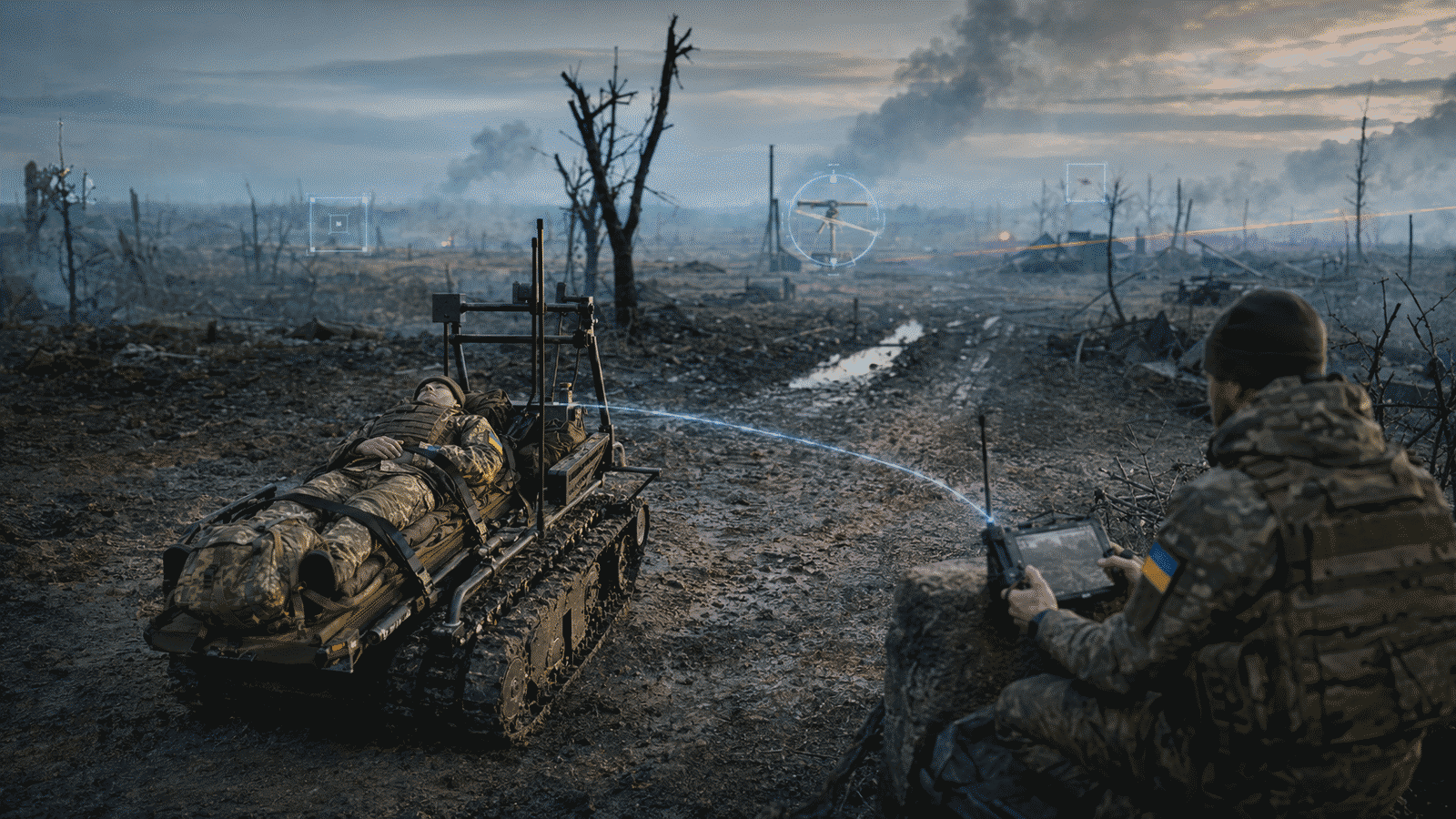
The primary purpose of Ukraine’s ground robotic systems is to remove soldiers from places where the risk of death is highest.
They deliver ammunition, food and water to frontline positions. They evacuate wounded personnel, transport equipment, conduct reconnaissance and perform mining or demining missions.
Ukraine’s ground robotic systems have already performed more than 100,000 logistical and evacuation missions instead of Ukrainian service members.
According to Ukraine’s Ministry of Defence, ground robotic systems carried out more than 100,000 logistical and evacuation missions during the first months of 2026.
Every such mission may represent a driver, medic, sapper or infantry soldier who did not have to cross an area covered by Russian artillery, drones or small-arms fire.
Armed ground systems are also being used more frequently. Yet removing a human being from the physical platform does not necessarily remove human control over the weapon.
Ukraine’s current procurement requirements emphasise remote operation and the transmission of video and data to an operator. Combat platforms are intended to engage defined targets rather than independently search for any person an algorithm classifies as hostile.
In one widely reported operation, a Ukrainian unit used ground robots and aerial drones to seize a Russian position without deploying infantry during the assault. Russian troops surrendered, while Ukraine reported no casualties among its personnel.
The importance of that operation was not that a machine had been authorised to decide who should die. Its importance was that technology allowed Ukrainian soldiers to complete a combat mission without being sent directly into enemy fire.
A robot can replace a soldier in a minefield, under artillery fire or on an exposed supply route. It must not replace human responsibility for deciding to take a life.
Ukraine’s right to survive is not a licence to do anything
Ukraine is not developing battlefield robotics in pursuit of technological superiority as an end in itself.
It is defending itself against a state that launched a war of aggression, occupies Ukrainian territory and continues to attack cities, critical infrastructure and civilian communities.
Article 51 of the UN Charter recognises the inherent right of individual and collective self-defence when an armed attack occurs. Russia and Ukraine therefore do not occupy morally or politically equivalent positions. Russia is the aggressor. Ukraine is exercising its right to defend its population, territory and sovereignty.
Any discussion that treats the aggressor and the country resisting aggression as interchangeable actors produces a false symmetry.
At the same time, international humanitarian law applies regardless of which side has the just cause for war. Ukraine’s right of self-defence does not remove the obligations to distinguish military targets from civilians, respect proportionality, take feasible precautions and protect those who surrender, are wounded or no longer participate in hostilities.
Explains why Ukraine may lawfully use force in response to Russia’s armed aggression.
Determines how that force may be used and protects civilians and persons no longer participating in hostilities.
The law governing the resort to force and the law governing conduct during hostilities answer different questions. Self-defence explains why Ukraine may use force. It does not permit every conceivable form of force.
The existential nature of the war explains the urgency of technological innovation, but it cannot erase legal limits. Conversely, international regulation should not be designed in a way that makes effective self-defence impossible for a country facing a larger aggressor that disregards those same limits.
A human “in the loop” is not enough
The international debate sometimes produces an overly simple formula: a weapon is acceptable if a person operates it and dangerous if a machine does.
Reality is more complicated.
Human beings can deliberately give unlawful orders, select civilian targets or disregard clear evidence that civilians are present. Human control is not meaningful when an operator merely confirms an algorithmic recommendation without sufficient information, time or authority to question it.
Between February 2022 and April 2025, short-range drone attacks killed at least 395 civilians and injured 2,635.
The UN reported that 89 per cent of these casualties occurred in Ukrainian-controlled territory as a result of attacks by Russian forces.
The UN Human Rights Monitoring Mission in Ukraine has documented short-range drone attacks on civilian cars, buses, ambulances and humanitarian or evacuation missions. Some of these incidents may amount to war crimes.
Most of these drones were not fully autonomous machines independently deciding to kill. Human operators were involved.
The UN findings on short-range drone attacks demonstrate that the physical presence of a person in the control chain does not automatically make an attack lawful.
Meaningful human control requires more than a button. The operator must have sufficient information about the target and the expected effects of the attack, time to assess the situation, the ability to interrupt the strike, clear rules of engagement and individual accountability.
The boundary is becoming more difficult to draw
It would be misleading to portray every Ukrainian robotic system as a simple remote-controlled vehicle carrying out fixed commands.
Ukraine’s defence industry is already integrating artificial intelligence into navigation, object detection, classification, tracking, ballistic calculations and operation under electronic warfare conditions.
The Wolly combat module, for example, is officially described as a remotely controlled, AI-enabled system capable of detecting people and vehicles, locking onto and tracking them, and calculating ballistic parameters for fire.
If an informed operator retains the final decision to engage, this represents one legal and operational configuration.
If a future version were activated and then allowed to identify a person, classify that individual as a lawful target and open fire without meaningful human authorisation, it would cross into the territory addressed by the UN–ICRC warning.
Loss of communication presents an especially difficult problem. On a battlefield saturated with electronic warfare, a requirement for uninterrupted manual control may render a system useless. Autonomous navigation, obstacle avoidance or return-to-base functions may be operationally necessary and legally acceptable.
But the ability to continue moving after losing communication need not include the ability to continue firing. A system may autonomously find its way back while entering a safe mode that prevents further attacks until communication and human control are restored.
What a responsible Ukrainian doctrine could look like
Ukraine has enough operational experience to become a rule-maker in this debate rather than merely the object of rules drafted by states that have never fought a comparable high-intensity defensive war.
A credible Ukrainian doctrine could begin with a clear principle: the deliberate decision to apply lethal force against a specific person must not be delegated entirely to a machine.
A person must retain the final, informed decision to use lethal force against another person.
Target type, territory, mission duration, operational environment and permissible force must be restricted in advance.
Operators must be able to interrupt, cancel or deactivate the system when circumstances change.
System outputs and operator decisions should be recorded whenever operational security permits.
A system must not unpredictably rewrite its own targeting rules while carrying out a mission.
Major changes to algorithms, sensors, munitions or intended use must trigger renewed legal and technical assessment.
Legal scrutiny should begin during research and development, not after a system has reached the battlefield.
Article 36 of Additional Protocol I to the Geneva Conventions requires states, when studying, developing, acquiring or adopting a new weapon, means or method of warfare, to determine whether its use would be prohibited under international law in some or all circumstances. For AI-enabled systems, this cannot be reduced to a one-time paperwork exercise.
Ukraine should shape the international debate, not withdraw from it
It would be inaccurate to claim that Ukraine has already endorsed every element of the regulatory model advocated by the UN and the ICRC.
Kyiv supported the first UN General Assembly resolution on lethal autonomous weapons in 2023, but abstained on the subsequent resolution in 2024. Ukraine has not publicly committed itself to a specific legally binding instrument.
That record reflects caution rather than indifference.
Ukraine has legitimate reasons to resist definitions so broad that they might restrict casualty-evacuation robots, autonomous navigation, defensive counter-drone systems or functions required to operate after communications are disrupted.
At the same time, an excessively narrow definition could allow developers to retain a human operator only formally, while the actual target selection and engagement process is controlled by an algorithm.
Regulation should therefore focus not on the vague concept of autonomy in general, but on autonomy in the critical functions of selecting targets and applying force.
The same legal line, but not a false moral symmetry
To an observer far from the war, a Ukrainian armed robot and a Russian armed robot may appear to be equivalent pieces of technology.
But technological similarity does not make their purposes, contexts or legal foundations equivalent.
One is employed by a state waging aggression. The other is employed by a state defending its population and territory. That distinction cannot be removed from the moral analysis.
Yet Ukraine also has a profound interest in preserving a universal red line.
The technologies being developed today will not disappear when the war ends. They will be exported, copied, modified and acquired by governments and armed groups that do not share Ukraine’s defensive purpose, battlefield discipline or legal commitments.
A capability created today to protect soldiers near Kharkiv, Zaporizhzhia or Pokrovsk may eventually be used in a completely different political and moral context.
Ukraine therefore has not only the right to develop robotic systems. It also has a unique responsibility to help define the boundary between legitimate military automation and the unacceptable delegation of human life-and-death decisions.
That boundary should not prevent a machine from evacuating a wounded soldier, delivering ammunition, clearing a road, crossing a zone under fire or protecting a position from an incoming missile or drone.
But it must stop the machine from independently deciding who is human, who is an enemy and who should die.
Ukraine is not asking for the right to outsource war to machines.
It is asking for the right to outsource danger to machines — while keeping human judgment, legal control and responsibility where they belong.
Ihor Zhdaniuk is a Ukrainian analyst and project manager specialising in public policy, infrastructure, environmental security and the regional consequences of Russia’s war against Ukraine.
Yevhen Hetman is a Ukrainian lawyer whose work focuses on human rights, international law and the legal consequences of Russia’s armed aggression.