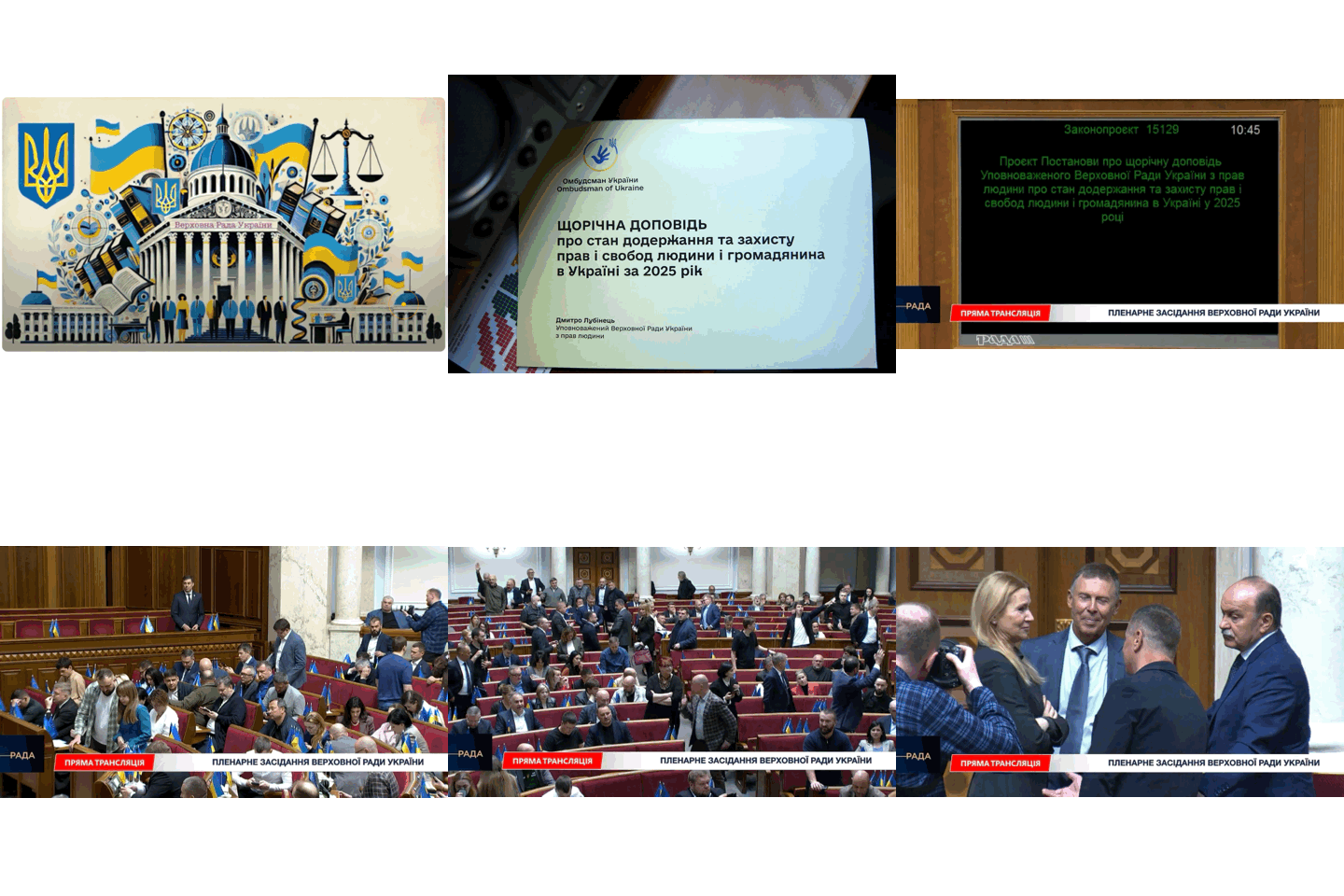
On 13 May 2026, the Annual Report of the Ukrainian Parliament Commissioner for Human Rights on the state of observance and protection of human and citizens’ rights and freedoms in Ukraine in 2025 was presented in the plenary hall of the Verkhovna Rada. Parliament adopted Resolution No. 15129, taking the report into consideration and recommending that public authorities process its findings and recommendations.
analytical infographic
No. 15129
Resolution of the Verkhovna Rada on the Ombudsman’s 2025 Annual Report
152,592
appeals received by the Ombudsman in 2025
4,785
monitoring visits and inspections
24,363
recommendations issued to public authorities
Parliamentary conclusion
The Ombudsman’s report became not a formal annual document, but a public test of how the state protects people in wartime.
On 13 May 2026, the Annual Report of the Ukrainian Parliament Commissioner for Human Rights on the state of observance and protection of human and citizens’ rights and freedoms in Ukraine in 2025 was presented in the plenary hall of the Verkhovna Rada of Ukraine. Following the discussion, Parliament adopted the relevant Resolution, registration No. 15129, taking the report into consideration and recommending that state authorities and local self-government bodies review its recommendations and take measures to ensure the proper protection of human rights and freedoms.
At first glance, this may appear to be a routine annual parliamentary procedure. In reality, it means much more. During a full-scale war, the Ombudsman’s report is not merely an institutional summary. It is a public measure of whether the state is capable of seeing the person behind the statistics, responding to violations, and preserving democratic standards under the pressure of wartime circumstances.
What was heard in the plenary hall was not statistics, but a map of human vulnerability
The 2025 Annual Report opens not with a dry institutional formula, but with an emphasis on a simple and profound truth: in the twelfth year of Russia’s aggression against Ukraine, human rights are not an abstract legal category. They are about whether a person will be heard when they need help. Behind every figure stands a specific human story, and behind every appeal — someone’s hope for a response from the state.
The report covers the rights of people affected by Russia’s armed aggression, internally displaced persons, residents of temporarily occupied territories, servicemembers, veterans, prisoners of war and missing persons, children, people held in places of detention, individuals facing discrimination, and citizens whose information and social rights require additional protection. A separate dimension of the document is the role of human rights in Ukraine’s European integration.
This breadth is what makes the report central to parliamentary consideration. It is not limited to a single sector and does not concern only one category of problems. It is a comprehensive portrait of a society living through war and of a state that must defend the country while preserving human dignity as the foundation of public policy.
152 thousand appeals: what the scale of public demand really shows
In 2025, the Ukrainian Parliament Commissioner for Human Rights received 152,592 appeals. Of these, 2,791 were collective appeals covering 87,614 people, while 149,801 were individual submissions. Compared with 2024, the number of appeals increased by 24%; compared with 2023 — by 59%; and compared with 2022 — by 260%. The hotline of the Ombudsman’s Secretariat received 63,025 calls.
The growing number of appeals is both a warning sign and proof that Ukrainians are increasingly aware of their rights and seek a state institution capable of intervening where an ordinary administrative response has failed.
The report also identifies three leading categories of applicants: family members of prisoners of war and missing servicemembers, representatives acting in the interests of relatives, and internally displaced persons. This is a revealing snapshot of wartime Ukraine. The most painful appeals arise where war destroys the basic pillars of life: family security, the right to know the fate of a loved one, the ability to preserve one’s home, and access to public support.
The scale of the Ombudsman’s work reflects the scale of the state’s challenges
In 2025, the Ombudsman’s Office carried out 4,785 monitoring visits. These included 2,082 inspections related to the rights of citizens affected by Russia’s armed aggression, including inspections of 1,066 shelters and bomb shelters; 936 inspections in the field of children’s rights; 481 inspections concerning information rights, including 98 in the sphere of personal data protection; and 626 visits to places of detention as part of the national preventive mechanism.
In addition, the Commissioner opened 6,161 proceedings, prepared 151 submissions, drew up 35 administrative offence protocols, processed 3,240 positions on draft laws and subordinate acts, and issued 24,363 recommendations to public authorities. The report states that in 2025, approximately 1.5 million human rights were restored or potentially restored as a result of the institution’s interventions.
Behind these figures lies an important political conclusion. In wartime, the Ombudsman is no longer only an institution responding to individual complaints. It is a system of continuous independent monitoring that examines shelters, conditions in places of detention, accessibility of public services, protection of children, the functioning of local authorities, and the real implementation of legislation wherever its violation directly harms people.
Human rights in the report are about the front line, the home front, and Ukraine’s European future
The particular strength of the Annual Report lies in the fact that it does not separate war and human rights into different realities. On the contrary, the document shows that war makes questions of human dignity, state accountability, and the rule of law even more urgent.
The rights of servicemembers and veterans, treatment of prisoners of war, support for families of missing persons, the return of Ukrainian children, protection of internally displaced persons, access to social and medical services, conditions in places of detention, the right to information, anti-discrimination safeguards, and the right to a safe environment — all these chapters of the report form not only a human rights agenda, but a state-building agenda.
The document directly links the proper protection of human rights to Ukraine’s capacity for European integration. Ukraine’s path toward the European Union is impossible without an honest assessment of how the state protects human dignity, upholds the rule of law, and guarantees the independence of the national human rights institution.
What the Verkhovna Rada’s decision of 13 May means
By adopting Resolution No. 15129, the Verkhovna Rada of Ukraine took the Ombudsman’s report into consideration and recommended that state authorities and local self-government bodies examine the report’s recommendations and take action within their competence. Parliament did not merely record the fact that the report had been presented. It transferred its conclusions into the sphere of responsibility of the entire public administration system.
After the parliamentary vote, the main question is no longer whether the report was heard. It was. The key question is what public authorities will now do with its recommendations.
If the recommendations remain only as pages of a major document, the state will lose the opportunity to use one of its most accurate instruments of self-assessment. If they become the basis for decisions — from legislative amendments to management discipline at the local level — the Ombudsman’s report will become a real mechanism for improving public policy.
The regional dimension: the Ombudsman’s recommendations must reach communities
The Resolution adopted by Parliament is addressed not only to central state authorities, but also to local self-government bodies. This is crucial, because a significant part of everyday violations — or, conversely, good practices in the protection of human rights — is shaped at the community level: through access to services, responses to citizens’ appeals, the work of social institutions, support for veterans and displaced persons, transparency of local decisions, and the willingness of authorities to listen to people.
Regional expert perspective
Ruslan Shamrin, Member of the Kryvyi Rih City Council, Member of the Standing Commission of the Kryvyi Rih City Council on the Implementation of the City Development Strategy and Investments:
“In communities, human rights are not reflected in abstract formulations, but in a concrete response to a concrete appeal. Will a veteran receive proper support? Will the family of a servicemember be heard? Will an internally displaced person have access to services? Can a citizen obtain information from a public authority without humiliation and months of waiting? That is why the recommendations contained in the Ombudsman’s Annual Report must be carefully processed not only in Kyiv, but also at the local level.”
For industrial, frontline, and large urban communities, including the Kryvyi Rih region, this framework is particularly tangible. Here, war, social pressure, environmental risks, and a strong public demand for quality services converge in one space. That is why implementing the Ombudsman’s recommendations is not a formality, but part of rebuilding trust between citizens and the state.
The Ombudsman’s report is a question about the type of state Ukraine is building
The Ombudsman’s 2025 Annual Report and its consideration by the Verkhovna Rada on 13 May raise the central question: what kind of Ukrainian state should emerge during the war and after victory?
A state where a person gets lost between agencies, formal replies, and closed doors? Or a state where a citizen’s appeal does not disappear in the system, but becomes a reason for action? A state that recognises human rights only in peaceful times? Or a state that proves, precisely in its most difficult period, that human dignity is not a luxury, but the foundation of its legitimacy?
On 13 May, the plenary hall discussed more than an annual document. It discussed whether Ukraine can build a strong wartime state without losing its human face.
Sources: Official web portal of the Verkhovna Rada of Ukraine; Annual Report of the Ukrainian Parliament Commissioner for Human Rights on the state of observance and protection of human and citizens’ rights and freedoms in Ukraine in 2025.