

Ukraine's Parliament during wartime | 1 September 2026
Ukraine's Prime Minister came to parliament with two numbers that define the country's immediate challenge: up to $30 billion in partner support that depends on Ukraine meeting agreed commitments, and a $27 billion gap in the defence budget. The Verkhovna Rada then opened its sixteenth session and backed the first reading of legislation restoring oversight of state aid - a reform that links European accountability with the survival needs of a country at war.
Why this matters internationally
In wartime Ukraine, legislation is not separate from national defence. Parliamentary votes determine whether partner financing can be released, whether defence procurement remains funded, whether social payments continue and whether communities can keep essential services operating under repeated Russian attacks.
A parliamentary sitting shaped by the war
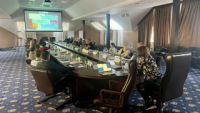
On 1 September, the Verkhovna Rada formally closed its fifteenth session and opened the sixteenth session of its ninth convocation. The procedure was constitutional and recognisably parliamentary, but the setting was unmistakably wartime. MPs were reminded that an air-raid alert would interrupt the sitting and require them to move to shelters. The chamber observed a minute of silence for Ukraine's defenders and civilians killed by Russian aggression before moving to political statements, the Prime Minister's address and recorded votes.
This combination is important for an international audience. The Ukrainian parliament continues to debate, amend and vote while the country is under daily missile and drone attack. Security restrictions affect the organisation of parliamentary work, but they do not remove the need for personal voting, committee scrutiny, public records or political responsibility.
Prime Minister Koretskyi's warning: the war is becoming more expensive
Prime Minister Serhii Koretskyi told MPs that a government audit had identified two immediate financial pressures. First, Ukraine may receive approximately $30 billion from its partners in 2026 under already approved support programmes, provided the country fulfils the commitments attached to that financing. Second, Ukraine still faces a $27 billion shortfall in its defence budget and is asking partners for emergency funding to cover it.
Koretskyi attributed the pressure partly to the changing nature of the war. Russia is increasing missile and drone attacks, while Ukraine needs more drones, ground robotic systems and long-range artillery to protect its forces and population. He also acknowledged that defence expenditure in the first half of the year had been partly financed from resources intended for the second half, creating additional pressure on the current budget.
The Prime Minister also made a politically significant admission: not all decisions agreed with international partners had been adopted, and the government itself had not completed all of its legislative work. In other words, the financing risk cannot be explained by the war alone. It is also a test of whether the executive and parliament can deliver agreed reforms on time.
The government's wartime delivery timetable
44 executive decisions - government resolutions, ministerial orders and other measures promised by 1 November 2026.
26 bills already in parliament - 12 on the agenda and 14 still awaiting inclusion, according to the Prime Minister.
17 government bills still to be submitted - around 11 promised within days and the remainder during September.
UAH 70 billion in identified savings - funds the government says will be redirected to defence without disrupting pensions, salaries or essential social obligations.
One month for a defence-needs audit - followed by monthly personal reporting from the Prime Minister on the government's part of the plan.
What parliament adopted
The Verkhovna Rada approved Resolution No. 15589 on the agenda of its sixteenth session with 244 votes. This is more than an administrative decision. The agenda defines the pool of legislation that parliament may consider at a time when defence financing, the 2027 budget, European integration and the release of international support are converging into one legislative timetable.
MPs also supported Bill No. 15437 at first reading with 249 votes. The proposal would restore parts of Ukraine's state-aid control system that were suspended after the introduction of martial law. It would strengthen monitoring of public support to businesses and assess whether such assistance is compatible with fair competition.
A crucial procedural distinction
Bill No. 15437 has not yet become law. A first-reading vote approves its general direction. The text must now be amended in committee, returned to the chamber for a second reading and supported in a final vote before it can proceed through the remaining constitutional stages.
The reform matters to the European Union because transparent state-aid rules are part of Ukraine's obligations under the EU-Ukraine Association Agreement and the country's wider accession process. During the parliamentary presentation, the responsible committee also linked final passage of the legislation to UAH 7.1 billion in budget support under the Ukraine Facility framework.
At the same time, wartime Ukraine cannot simply copy a peacetime control model. The bill provides special treatment for territories affected by active hostilities or temporary Russian occupation. Before the second reading, MPs have also promised to clarify the treatment of the "5-7-9" affordable-loan programme, the eOselia housing programme, public service obligations and municipal support for water, heating, transport and other local services.
The regional test: what the reform means for Kryvyi Rih
For industrial cities such as Kryvyi Rih, the debate is not abstract. Local authorities may need to support public utilities, transport services, relocated enterprises and companies whose production facilities, warehouses or energy systems have been damaged by Russian attacks. These measures can look like state aid in legal terms, but in wartime they may also be essential instruments of resilience.
Regional perspective
Ruslan Shamrin, a member of Kryvyi Rih City Council and a member of the City Council's Standing Commission on the Implementation of the City Development Strategy and Investment, places the emphasis on the distinction the final law must preserve.
From a regional perspective, transparent and EU-compatible state-aid rules are necessary. But support that keeps water, heating, public transport, industrial production and jobs functioning under attack cannot be assessed in the same way as an ordinary peacetime market advantage. For Kryvyi Rih, the quality of the second-reading text will be measured by whether it protects both fair competition and the capacity of an industrial community to survive, recover and invest.
This regional perspective reveals the central policy challenge. Weak oversight can allow public money to be captured by politically connected recipients. Rules that are too rigid, however, can delay essential assistance to communities and businesses living under daily security risks. The second reading must build a credible legal bridge between these two realities.
How a wartime parliamentary decision becomes a practical result
1. Parliamentary mandate - MPs approve the bill's general direction at first reading.
2. Committee revision - wartime safeguards, municipal services and existing support programmes must be clarified.
3. Final parliamentary vote - the revised text must secure a majority in the chamber.
4. Implementation - government bodies, the competition authority and local governments adapt registers, procedures and aid programmes.
5. Measurable impact - partner financing, transparent public support and functioning local services become the real test of the legislation.
What Ukraine's partners should watch next
By the end of September: whether the government submits all 17 bills it identified as unfinished work.
By 1 November: whether the promised 44 executive decisions are adopted.
During the second reading of Bill No. 15437: whether parliament preserves effective competition oversight while protecting legitimate wartime and regional support.
In the defence budget: whether the announced UAH 70 billion in savings is actually redirected, whether the defence-needs audit is completed and whether the Prime Minister's monthly reporting becomes a public accountability mechanism.
In wartime Ukraine, parliamentary procedure is not a pause from national defence. It is one of the mechanisms through which defence is financed, partner confidence is maintained and communities are given the legal capacity to endure.
Sources and methodology
This analysis is based on the official transcript and voting record of the Verkhovna Rada sitting of 1 September 2026, the official parliamentary agenda, the Verkhovna Rada's information on Bill No. 15437 and the official Kryvyi Rih City Council directory. The article distinguishes between statements made during parliamentary debate, decisions adopted by recorded vote and editorial analysis of their likely national and regional consequences.
Official sources: parliamentary transcript; agenda and status of decisions; recorded vote on Bill No. 15437; official summary of Bill No. 15437; Kryvyi Rih City Council.